 Clinical Insights
How Accurate Digital Scans Lead to Better Restorations: A Laboratory Perspective
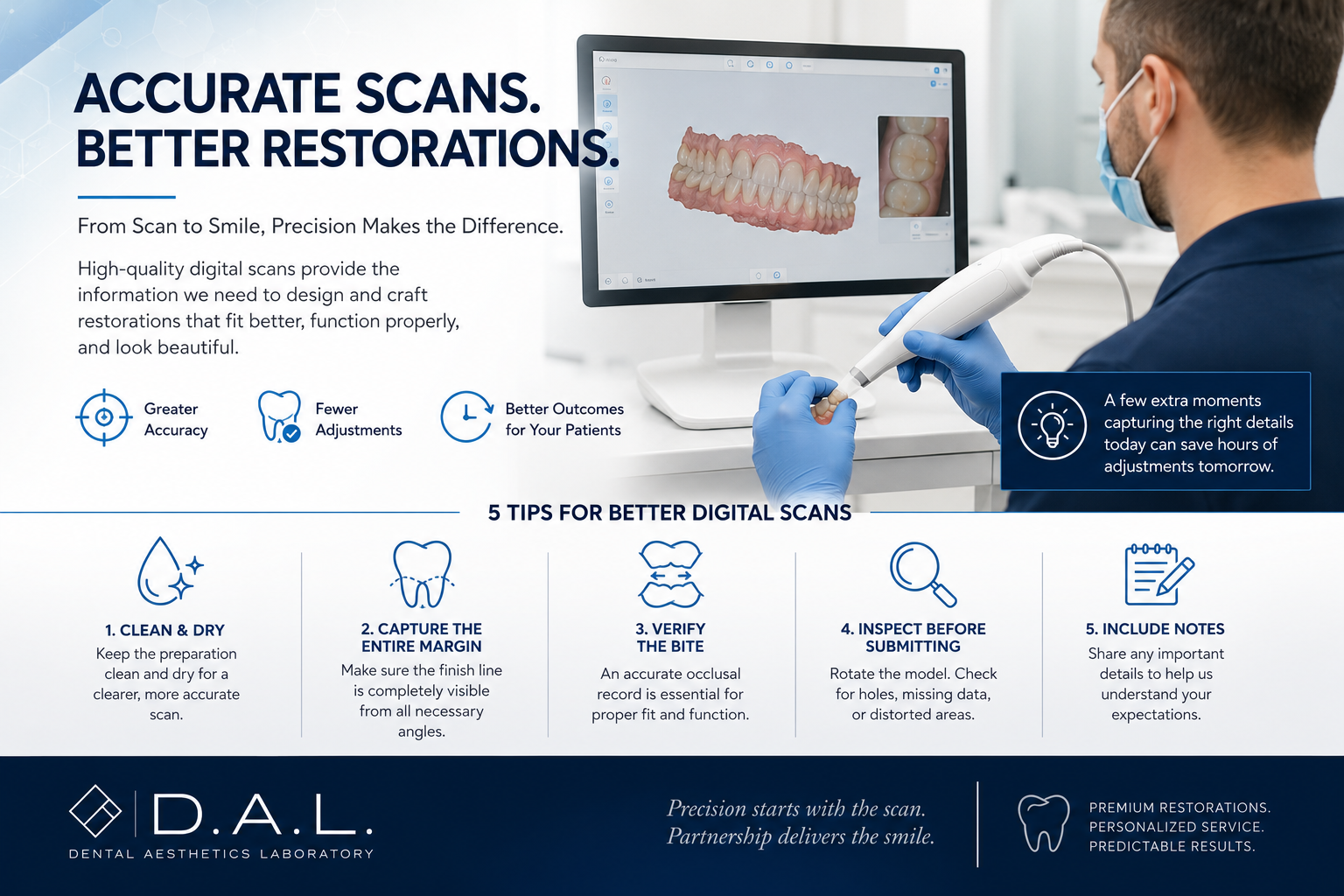
Digital dentistry has transformed the way dental practices and laboratories work together. Today’s intraoral scanners produce highly detailed digital impressions that can improve communication, increase efficiency, and reduce the need for remakes. However, even the most advanced scanner cannot compensate for an incomplete or inaccurate scan.
From the laboratory’s perspective, the quality of the final restoration begins with the quality of the digital impression.
Why Scan Accuracy Matters
Every restoration is only as accurate as the information the laboratory receives. When digital scans clearly capture the preparation margins, occlusion, adjacent teeth, and surrounding tissue, the laboratory can design restorations with greater confidence and precision.
Incomplete or distorted scan data can lead to:
- Poor marginal adaptation
- Open or tight interproximal contacts
- Occlusal discrepancies
- Additional chairside adjustments
- Delays due to rescanning or remakes
A few extra seconds spent verifying a scan before submission can save valuable chair time later.
What We Look For in the Laboratory
When a digital case arrives, our first priority is evaluating the quality of the scan. Before design begins, we verify several key areas:
- Clearly defined preparation margins
- Complete capture of the preparation without missing data
- Accurate opposing arch scan
- Reliable bite registration
- Minimal artifacts caused by saliva, movement, or reflective surfaces
- Adequate visualization of adjacent teeth and surrounding anatomy
If any of these elements are missing, the restoration may require additional communication before production can begin.
Five Tips for Better Digital Scans
1. Ensure the preparation is clean and dry.
Moisture, blood, and debris can obscure margins and reduce scan accuracy.
2. Capture the entire margin.
Review the preparation from multiple angles to confirm the finish line is completely visible.
3. Verify the bite registration.
An accurate occlusal record is just as important as the preparation scan.
4. Inspect the scan before submitting it.
Take a moment to rotate the model and look for holes, missing data, or distorted areas.
5. Include notes when appropriate.
If a case has unique esthetic or functional requirements, adding a brief note helps the laboratory understand your expectations from the beginning.
Better Communication Creates Better Results
Digital technology has improved efficiency, but successful restorative dentistry still depends on communication between the dentist and the laboratory.
When clinicians and technicians work together, questions are resolved earlier, expectations are clearer, and patients benefit from restorations that require fewer adjustments and deliver more predictable results.
The Laboratory Difference
At Dental Aesthetics Laboratory, every digital case is carefully reviewed before production begins. Our goal is not simply to manufacture a restoration quickly, but to provide one that seats predictably, functions properly, and meets the esthetic expectations of both the dentist and the patient.
We believe that precision begins long before milling or finishing—it begins with the quality of the digital scan.
About Dental Aesthetics Laboratory
Dental Aesthetics Laboratory partners with dentists throughout South Florida to provide premium digital restorations, implant solutions, and personalized laboratory support. Every case is reviewed by an experienced master ceramist to help ensure consistent quality, excellent communication, and dependable results.
Have a question about a digital case? Contact our team—we’re always happy to help before treatment begins.
Hi, this is a comment.
To get started with moderating, editing, and deleting comments, please visit the Comments screen in the dashboard.
Commenter avatars come from Gravatar.